



M193 VS SS109 – Understanding 5.56×45mm Ammunition
Booth M193 and SS109 (M855) are 5,56×45 ammunitions. Just looking at the Cartridges you normally cannot see the difference. In some cases the SS109/M855 is marked with a green tip but not necessarily. The 5,56×45 Remington was developed for the 1960’s new US assault rifle M16. But during service they realized that the bullet had a poor performance on long range (over 100 meters) and that it was easily disturbed by branches and grass. Therefore a new bullet was developed that has a higher weight and a different ballistic behavior. The idea was that the bullet should be able to penetrate a steel helmet on 300 meters distance – the SS109/M855 was developed. In order to meet up with the helmet penetration capability a steel tip was inserted (see the picture) while the M193 only consist of a lead core. SS109 was designated as the NATO standard bullet 1980 and still is.
Why M193 Dominates at Short Range
Despite the poor long-range performance M193 is much more aggressive to armour steel than the ss109 on short distance where all standard ballistic tests are performed. Assault rifles protection levels are tested at different range depending on standard. EN and VPAM are tested on 10 meters, NIJ on 15 meters and STANAG on 30 meters. For all these distances the m193 is much more aggressive. The speed tested normally is for M193 around 1000m/s which is a normal muzzle velocity while SS109 normally is tested at 950 m/s even though the normally factory charged cartridges rarely gives a muzzle velocity over 920m/s. The main reason for the higher penetration capability for M193 on short range is the higher speed. However there are theories of how different the lead behaves between the two bullets on the impact. To stop the bullets with a HB500 armour steel like Swebor Armor 500 6,5mm is needed to stop the ss109 at 950 meters per second and for M193 you need 10,0mm to stop the bullet at 1000m/s.
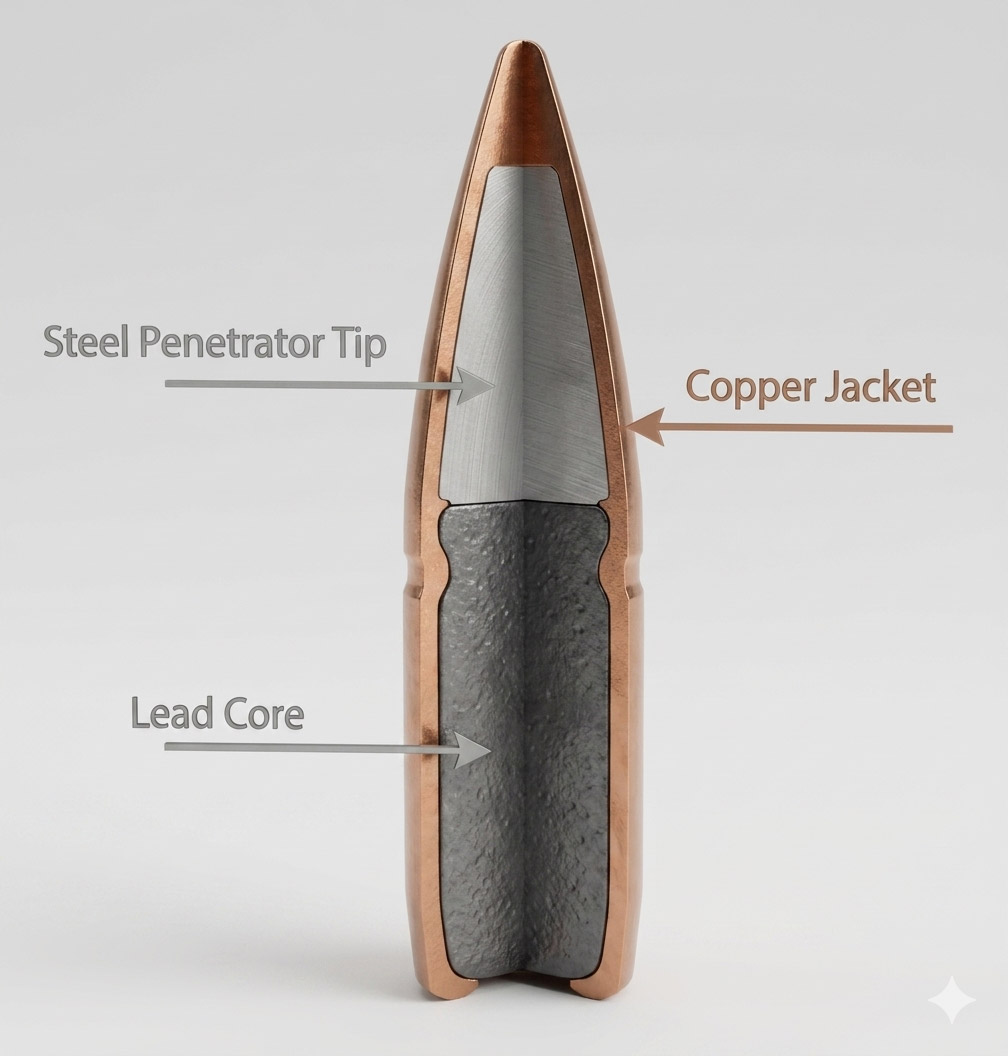
Identifying M193 vs. SS109
The only real way of differ between two cartridges of SS109 and M193 is by using a magnet. M193 is filled with lead and is therefore nonmagnetic while the steel tip in SS109 makes it magnetic.
Ballistic Protection Standards
The STANAG (STAndard Nato AGreement) is a standard for blast and ballistic protection that shall correspond to a situation on the battlefield. There fore the stanag test is performed on 30m distance with a lower strike velocity than the expected muzzle velocity.STANAG class 1 consists of the booth two bullets (and 7,62×51 ball) but it is M193 that is the most aggressive one despite lower strike velocity. Max strike velocity in STANAG 1 are: SS109 920m/s and M193 957M/s.
So there are three protection levels to consider when it comes to protection of 5,56×45 ammo:
- SS109 at 950 m/s – 6,5mm Swebor Armor 500 or 4,8mm Swebor Armor 600
- M193 at 957 m/s – 9,0mm Swebor Armor 500 or 5,7mm Swebor Armor 600
- M193 at 1000 m/s – 10,0mm Swebor Armor 500 or 7,0 mm Swebor Armor 600